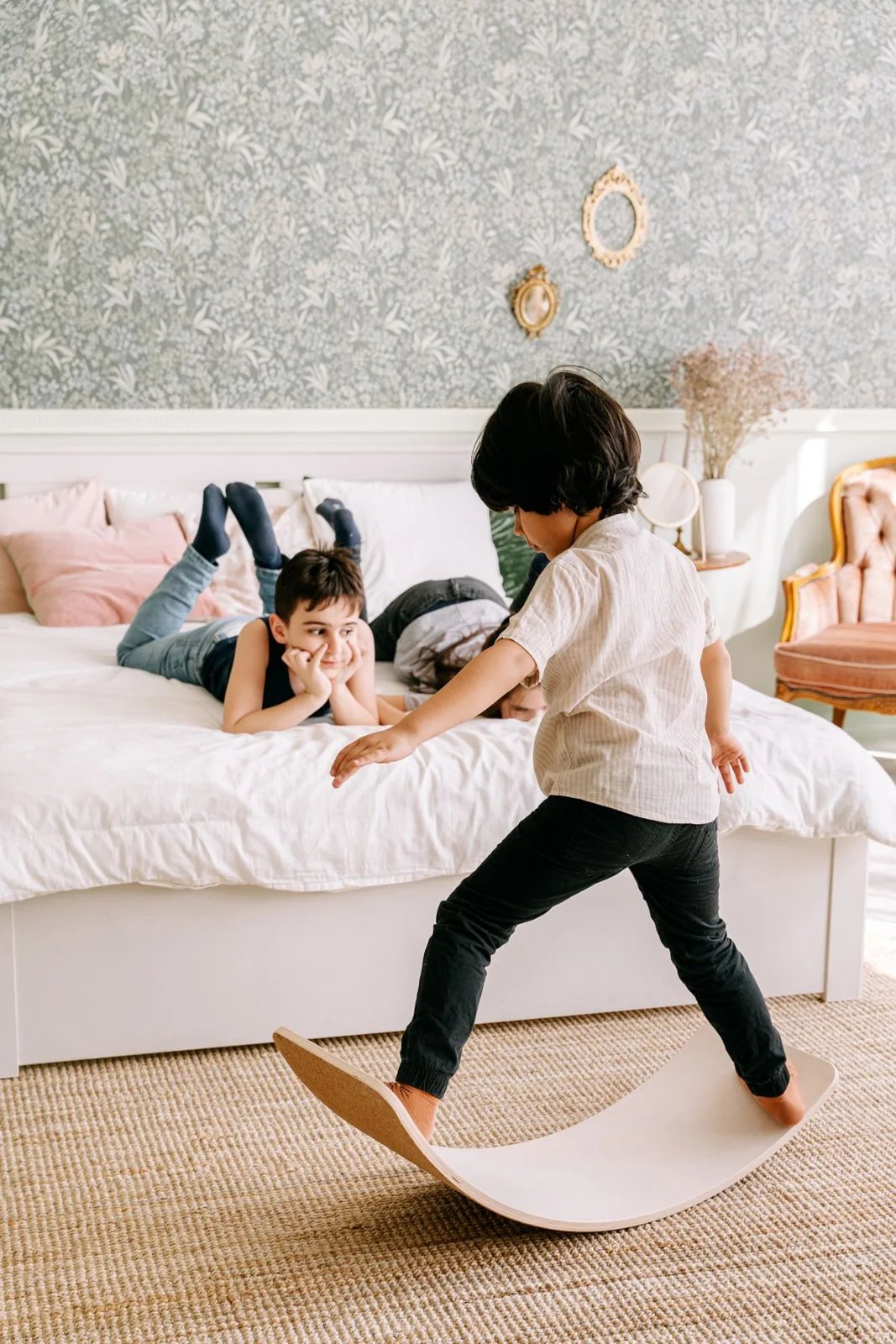
Children can share a bedroom and still want a place for something that belongs particularly to them. Personal space may be a drawer, one section of a shelf or a small box, rather than a large change to the room.
Begin by asking what each child wants to keep separate. The answers may be specific and modest: a drawing notebook, a favourite collection or a book they are still reading.
Identify the jobs the room needs to do
Look at sleeping, dressing, reading and storing belongings. Keep routes to the door clear and check that furniture is stable and used as intended.
Notice where conflicts actually happen. One child may need to reach clothes while another is sitting in front of the wardrobe. Moving a small basket could help more than dividing the room down the middle.
Avoid building a solution around equal-looking spaces alone. Children of different ages may need different storage, but the arrangement should be understandable and usable for both.
For a younger child, keep their everyday clothes and familiar objects in simple reachable places. An older child might need a separate folder for schoolwork or somewhere to leave a partly finished project beyond a younger sibling's access.
Agree what personal storage means
Give each child a clearly recognisable place. They can choose a label, colour or drawing without needing matching new containers.
Discuss which things are shared and which require asking first. A communal block basket can remain available to both children while a personal notebook stays in its owner's drawer.
Keep the rule practical: ask before taking an item from somebody else's personal space, and accept the answer. Adults may need to help younger children practise the sequence rather than expecting a label to resolve every disagreement.
Personal storage does not need to become secret storage for unsuitable items. Adults remain responsible for age-appropriate access and supervising materials that require it.
If one child wants to display a collection, agree the available area and how it can be changed. Do not let a growing display quietly occupy the other child's space.
Test the arrangement during ordinary routines
Try it through a few mornings and evenings. Can both children find clothes, reach books and put things away without moving the other's belongings?
For different bedtimes, think about light and noise. A book that can be taken to the living room may be a more workable evening choice than an activity beside a sleeping sibling.
Invite specific feedback: “Is your drawer easy to open?” or “Where could this unfinished model rest?” Broad questions about whether the room is fair can be harder to answer constructively.
Adjust one point at a time. If a shelf becomes crowded, reduce or relocate the contents before adding more storage.
Return to the discussion as interests and routines change. The aim is a room each child can use comfortably, with a few boundaries that make sharing less dependent on constant adult negotiation.
Make it work for your family. Keep the useful bits and change the rest.