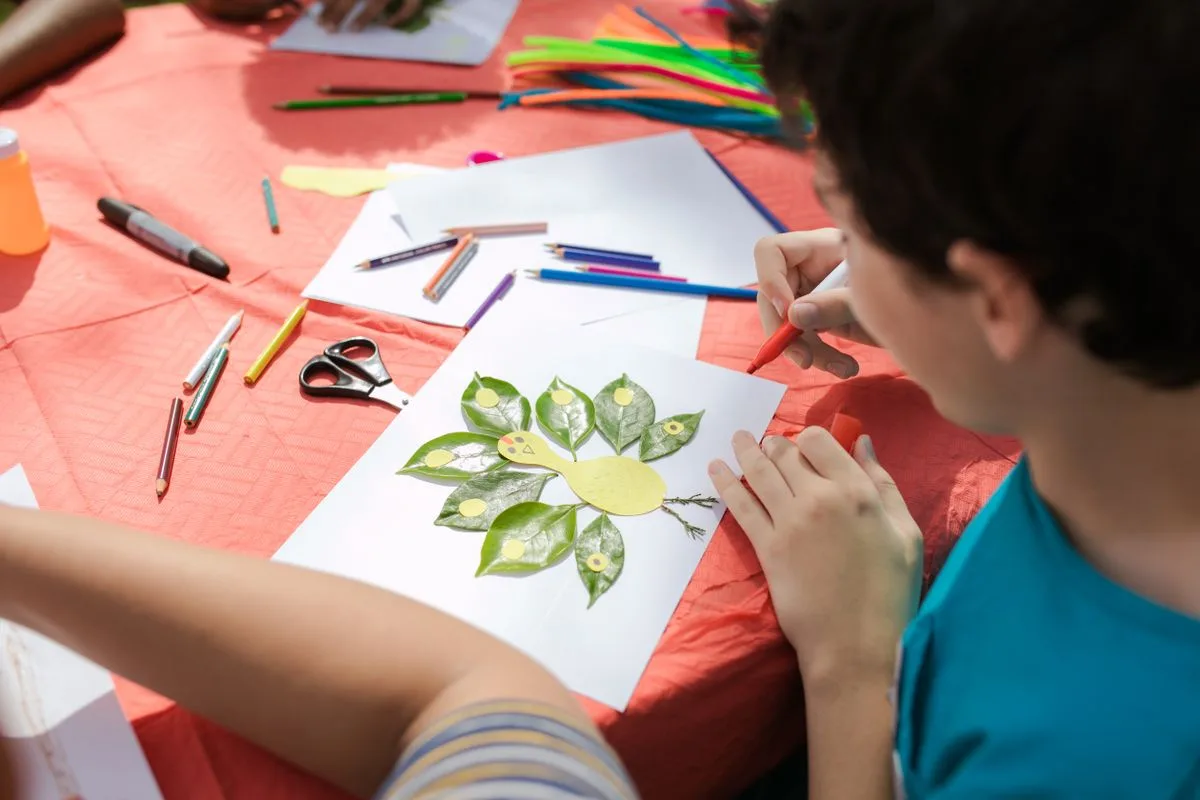
Leaf rubbing reveals details that are easy to miss when looking at a leaf from above. The veins and edges appear gradually as a crayon moves across paper. A few suitable leaves are enough; filling a carrier bag is unnecessary.
Choose fallen leaves from a place where collecting is permitted. Leave unknown plants untouched, avoid damaged or dirty specimens and wash hands after handling outdoor materials. Do not use the activity as a reason to pick leaves from planted displays.
Find leaves with useful texture
Look for leaves that lie reasonably flat and have visible veins on the underside. Very curled, brittle or soggy leaves are harder to use. Take only a small selection, perhaps one broad leaf and one with a different outline.
If collecting is impractical, ask another adult to bring suitable fallen leaves or inspect leaves already in your garden with permission. Children can still choose between them at the table. A photograph is useful for drawing, but it will not supply the raised texture needed for a rubbing.
Keep the leaves on a tray until you are ready to work so fragments do not spread across the room.
Hold the layers still
Put one leaf vein-side up on a hard, flat surface. Lay plain paper over it, with enough room around the outline. Thin paper usually shows texture more easily than heavy card. Test a corner before arranging a whole page.
Use the side of an unwrapped wax crayon to rub gently across the leaf. An adult can steady the paper at the edges while a younger child makes broad strokes. Keep the crayon low rather than using its pointed end to draw over every vein.
If the image is faint, try slightly firmer strokes or a different crayon. If the leaf shifts, stop and realign the layers. A little tape holding the paper to the table may help, provided the surface tolerates it.
Build a collection through differences
Make one rubbing per small sheet or leave a clear gap between leaves. Children can compare shapes without needing to identify the tree. A label such as “pointed leaf from beside the gate” records a real observation without guessing a species.
Older children might use two colours lightly over one leaf or arrange several outlines into a border. Younger children can choose a colour and watch the pattern emerge. Avoid turning the session into a test of neatness; partial outlines can still show interesting details.
If a child wants to identify a leaf, use a reliable field guide and keep uncertain labels tentative.
Save the paper rather than every leaf
Let children choose two or three rubbings for a folder, postcard or simple folded booklet. Add the date and place if they want a record of the outing. Leave space for another page from a different season.
Return or dispose of the leaves appropriately and wipe the working surface. The paper collection keeps the textures without leaving a tray of crumbling leaves waiting for another job.
Make it work for your family. Keep the useful bits and change the rest.