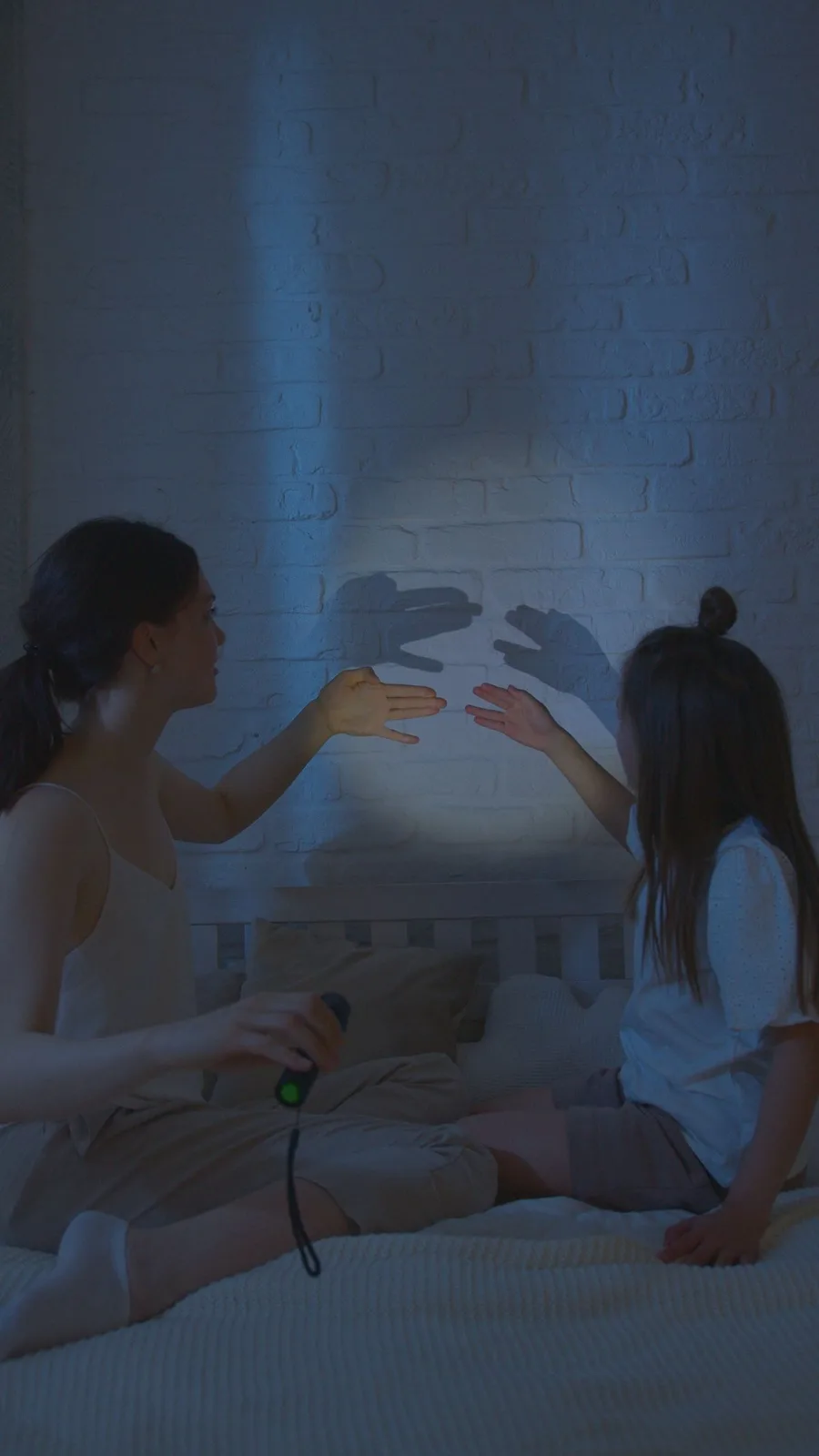
A torch and a plain wall can turn a short patch of evening into an exploration of shapes. Children can see a familiar hand become enormous or watch a toy's outline change as it turns. Start with a little background light so the room remains easy to move around.
Use an intact torch with a secure battery compartment. An adult should check it before play and keep spare batteries out of children's reach.
Arrange a clear viewing space
Choose a wall or a hanging sheet that is already secure. Move breakable objects out of the way and leave a clear path to the room's usual light switch. Nobody needs to stand on furniture or hide in a cupboard to make the shadows.
Hold the torch at a comfortable distance and point it towards the wall, away from eyes. Start with hands as the only objects. One person can hold the light while another makes a shape, then swap if both can manage the torch appropriately.
A child who dislikes darkness can keep more lights on and work closer to the wall. The outline may be softer, but participation should remain comfortable.
Change distance before adding complexity
Hold a hand between the light and wall. Move it slowly towards the torch, then towards the wall, while keeping the torch still. Ask what changes in the shadow. Let children describe what they see before offering explanations.
Try the same movement again so they can check their observation. An older child might mark two standing places with removable paper on the floor. A younger child can simply choose “nearer” or “farther” for the next attempt.
Change one position at a time. If torch, hand and viewer all move together, the interesting effect becomes harder to follow.
Compare objects by their outlines
Bring out three large, familiar objects, such as a wooden spoon, a toy animal and a cardboard shape. Turn each slowly in the beam. A spoon seen from the side may look very different from its broad face.
For a guessing game, let one child choose an object from the agreed collection while the others look at the shadow. Keep the game gentle; an impossible outline can become a shared puzzle rather than a failed guess.
Turn the outlines into a scene
Children who enjoy stories can combine two shadows for a tiny scene. Someone else can narrate while the shadow-makers concentrate on moving their objects. Short scenes are easier to see than a crowded wall of hands.
Finish with the room lights on
Before packing away, invite each child to recreate one change they liked. This gives the session a final discovery without requiring a written explanation or finished artwork.
Switch the normal light back on, collect objects and return the torch to its usual adult-approved storage. If children want to continue another night, note a simple question such as whether a different toy makes a recognisable shape. The next session can begin there without needing a new set-up.
Make it work for your family. Keep the useful bits and change the rest.