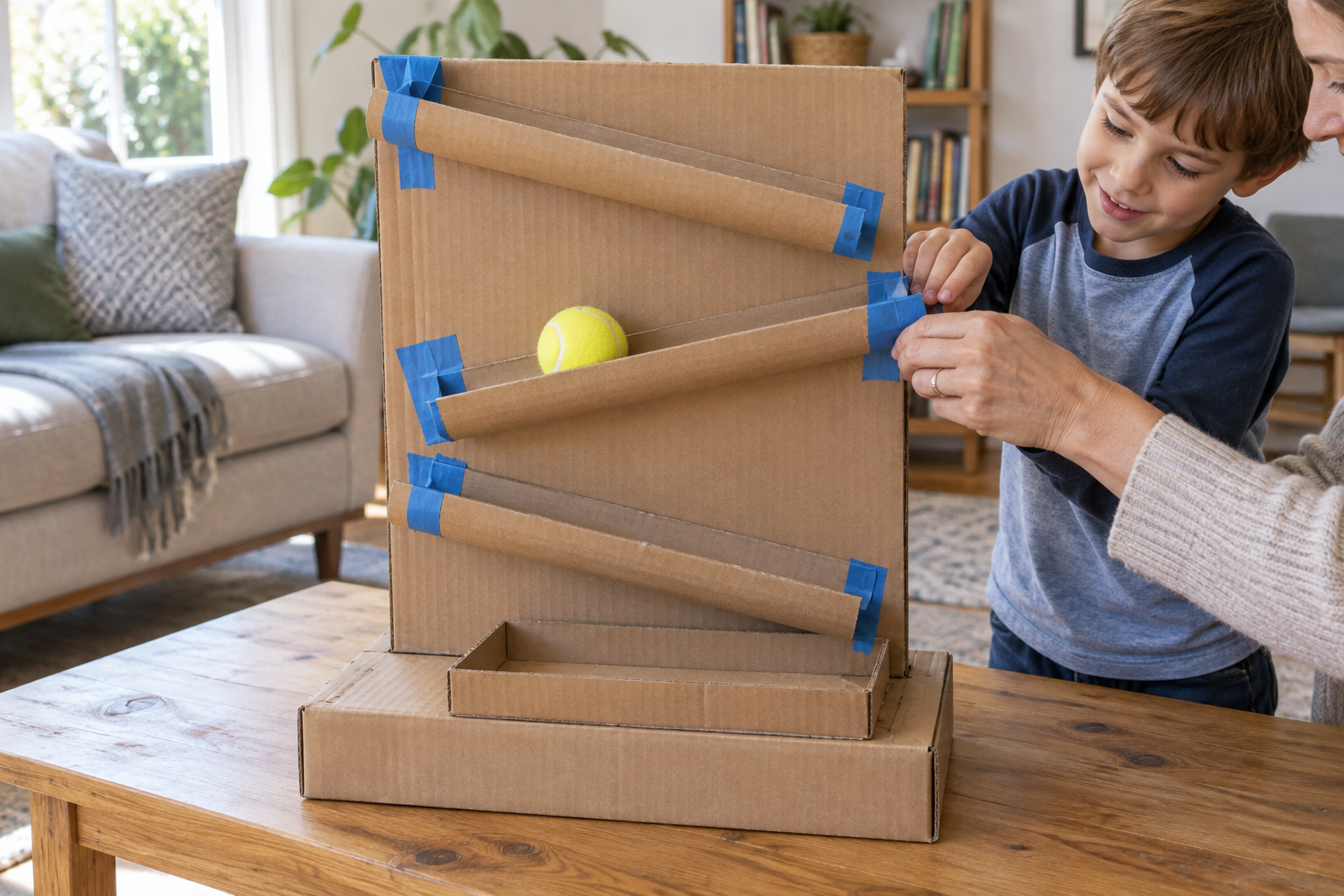
A ball run can be built with a ball large enough to suit the youngest child present. Marbles are unnecessary. The challenge is making a broad path that guides a lightweight ball down a gentle slope and into a waiting box.
Choose an age-appropriate ball and match the cardboard channels to its size. An adult should handle cutting and check for staples, sharp edges or loose pieces before play begins.
Start with one open channel
Fold a wide strip of sturdy card into a shallow U shape, or use an open cardboard tray. The ball should roll freely without squeezing between the sides. An open top lets children see where it slows or catches.
Rest one end slightly higher than the other using a low, stable support. Keep the whole run near floor level and away from walking routes. Avoid attaching it to furniture in a way that could damage the surface or pull objects down.
Put a shallow box at the bottom to collect the ball. Test this first section before adding turns, tunnels or decorations.
Watch the first roll together
Place the ball at the top and let go without pushing. Notice whether it reaches the box, stops midway or leaves the side. Ask children where they think the problem begins, then repeat the roll from the same place.
A rough join may catch the ball. A narrow channel may squeeze it. Too steep a slope can send it beyond the collector. Change one feature at a time so the next attempt gives useful information.
Younger children can release the ball while an adult adjusts the channel. Older children may enjoy marking a start point or drawing the path before rebuilding it.
Add a second section carefully
Once the first channel works, extend it with another wide piece of card. Overlap the upper channel onto the lower one so the ball is less likely to hit an upward-facing edge. An adult can secure joins using tape appropriate to the materials.
Try a gentle change of direction rather than a sharp corner. Children can build a broad curved collector at the join or place the lower channel at a slight angle. Keep testing after each addition instead of constructing a long run that has several unknown problems.
Divide the testing jobs
If siblings work together, one can check the landing box while another releases the ball. Swap jobs. Agree that nobody dismantles a section while a roll is underway.
Keep the successful part reusable
Finish with a few rolls through the version that works best. Take a picture if children want to remember the supports and joins. Store intact channels together, with the ball in its ordinary toy home so its suitability remains obvious.
Flatten damaged card for appropriate recycling and remove tape as required locally. The next session can add one new feature to the successful section. A short, reliable run often offers more play than a huge construction that only works when an adult holds it together.
Make it work for your family. Keep the useful bits and change the rest.